
The world of service packaging and the hospitality industry is changing all the time. The pace of innovation is rapid, while the pressure to reduce packaging waste is growing. The Packaging & Packaging Waste Regulation (PPWR) states that the amount of packaging waste per capita must be reduced by 5% by 2030. For smart companies, this presents numerous opportunities to innovate.

In a highly competitive market, large investments may be unaffordable for individual players. This is why more and more companies are opting for collaboration, where shared systems and solutions deliver efficiency and benefits for everyone. With the new requirements looming, it may also be smart to invest as a first mover and to communicate strategically.

Discover the impact of the PPWR on service packaging and the hospitality sector, and what new trends and innovations are already shaping the future.

serviceverpakkingen

PPWR for service packaging and the hospitality industry

Timeline PPWR

This list is not exhaustive: it contains the most important points from the PPWR that are relevant to service packaging and the hospitality industry. More information can be found on our PPWR page.

Please note: The European Commission is still working on an official FAQ and additional delegated and implementing acts, which may contain further clarification or changes. These documents have not yet been published. Keep an eye on official EU sources and national guidelines for the latest information. Fost Plus is not liable for any inaccuracies or omissions in this list, or for the consequences of actions taken on the basis of it. We recommend that you first seek legal advice.

For producers* 

a. Prepare for registration in each EU country where you supply products (2027): once the national PPWR register opens in each Member State (18 months after the February 2026 implementing act), you must be registered before you place packaging on the market.

b. Prepare your information and keep it up to date in accordance with Annex IX (reporting from 1 June after the first full year): record the quantity and type of material, the type of packaging (primary/secondary/transport packaging) and reusable packaging systems (if applicable) for each order. This information must be submitted annually.

* Producer: makes packaging available for the first time in a Member State (e.g. Belgium) and may be the manufacturer, importer or distributor (authorised representative for EPR if the producer is not established in the Member State).

Note: Micro-enterprises may continue to use certain types of packaging under certain conditions if there is no viable alternative or no access to reuse facilities and if the Member State approves this exception.

a. Plastic packaging in hospitality businesses for consumption on the premises
Cups, plates, trays and other packaging for food and drinks consumed on the premises in dining areas (including food courts and terraces) may no longer be made of plastic. Exception: hospitality businesses that do not have access to drinking water.

b. Individual portion packaging in the hospitality industry
Sauces, coffee creamer, sugar, jam and seasoning in single-use plastic packaging and consumed on the premises will soon be a thing of the past. Exceptions include takeaway meals that are eaten immediately or in care facilities where individual portions are required for medical reasons.

c. Packaging for care products in hotels
Single-use packaging for shampoo, soap, lotion and other personal care products offered with individual bookings in hotels or other accommodation will be prohibited.

d. Very light plastic carrier bags (<15 micron)
These thin bags will disappear, except where necessary to prevent food waste (e.g. for loose fruit) or for hygiene reasons.

Read our blog post about restrictions or see all the details in PPWR Annex V

a. From February 2027, hospitality businesses must give consumers the option of bringing their own packaging or containers (bring-your-own). They must also clearly inform customers of this possibility.

See all the details in PPWR Art. 32
 

b. From 2030, they must aim to offer 10% of products for sale in reusable packaging.

See all the details in PPWR Art. 33
 

c. From 1 January 2030, companies must ensure that 40% of their transport packaging is reusable. This applies to the packaging types listed in Article 29(1): pallets, folding crates, boxes, trays, plastic crates, IBCs, pails, drums and canisters. What is more, this packaging must be fully reusable from 2030 in internal logistics within Belgium or between linked companies in EU Member States. Article 29(4)(d) explicitly excludes cardboard boxes.
See details in PPWR Art. 29 – more details here
 

d. At least 10% of the grouped packaging used to combine products (whether packaged or not) into a stock or inventory unit must be reusable by 2030, with a target of 25% by 2040, excluding cardboard.

Read our blog post with the definition of reusable packaging or see all the details in PPWR Art. 29

For so-called closed-loop systems, the packaging must also have a data carrier (such as a QR code) stating where it can be returned.

Read our blog post with the definition of reusable packaging.

See all the details in PPWR Art. 29 and ANNEX VI (loop systems).

This means it must meet the design-for-recycling criteria set out in the delegated acts (Article 29(2)(a)). Packaging must achieve recyclability class A, B or C from 2030, and class A or B from 2038. The European Commission will establish detailed design-for-recycling criteria by 1 January 2028. Article 29 (11) contains a list of exemptions from the recyclability requirement. Read our blog post about recyclability.

See all the details in PPWR Art. 6

One of the possible strategies relevant to the hospitality industry is defined here: Article 43. 6. Member States shall incentivise restaurants, canteens, bars, cafés and catering services to serve their customers tap water, where available, free of charge or for a low service fee, in a reusable or refillable format.

R-strategies for service packaging and the hospitality industry

Below, we share our insights on possible strategies and offer inspiration for experimentation and innovation by companies.

Preventie

Eliminating packaging is not always practically feasible. Even so, this can be an opportunity for hospitality businesses to rethink the dishes they serve – ice cream in a cone or soup in a roll, for instance. What’s more, consumers increasingly expect to be given a choice: whether they want a fork, knife or spoon, whether they want a bag or not, and so on.

eliminatie serviceverpakkingen

Select packaging based on the product and strike the optimal balance between the ideal size for each dish and the volumes needed to achieve economies of scale. Your packaging supplier can be a partner in this.
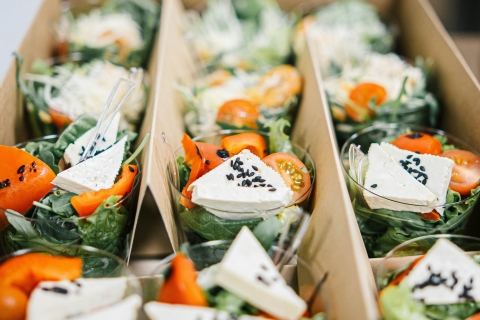
oververpakking en verpakkingseliminatie

Hospitality businesses will have to allow consumers to bring their own packaging. This is a development that offers new opportunities for both the businesses and producers of service packaging, creating space for new products, services and supporting materials, such as hygiene tools and communication stickers. For hospitality businesses, it’s a way to optimise costs and offer customers an extra service. Consumer packaging may be refused if it is not hygienically acceptable.
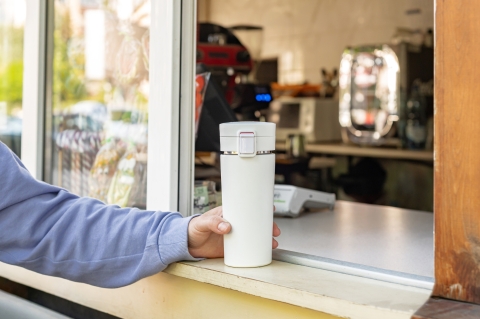
refill on the go
Hergebruik

With reusable packaging, a minimum number of rotations must be guaranteed. An efficient returns system is therefore crucial, with a deposit refund or reward for returns and enough return locations through a network of retailers or even return vending machines (RVMs). To organise this easily and efficiently, it’s best not to work alone. Collaboration within a broader system quickly makes business cases positive. Various innovative businesses – including pool providers, laundry facilities and software vendors – offer a wide range of services to help you with this. You can find them in our MatchMaker.
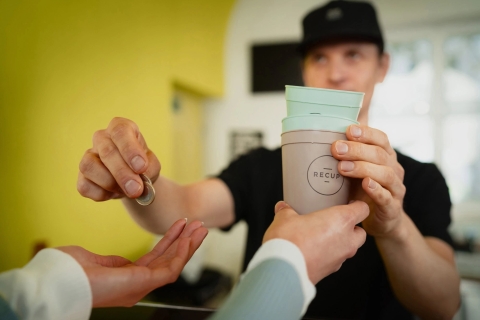
return on the go

Many meal delivery companies offer consumers the option of receiving their orders in reusable packaging. They can then return the reusable packaging directly from their front door when they receive their next delivery, usually in combination with a reward or deposit to encourage returns and reward customer loyalty. Read our blog about home deliveries.
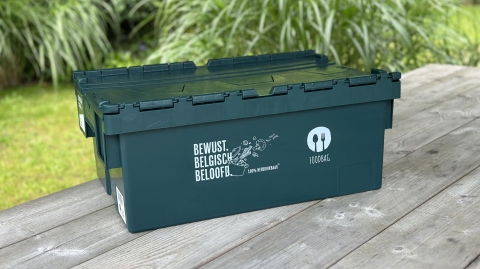
Return from home
Ecodesign

When designing or redesigning service packaging, ensure it is recyclable by using our general Design for Recycling Guideline and the Design4Recycling FAQ
The examples below are very likely to be banned from the EU market by 2030 under the new PPWR legislation:


  • PVC packaging must be replaced with recyclable alternatives such as PE, PP, PS, PET, aluminium, steel or glass. Note that paper-cardboard packaging is not recommended for ready meals in Belgium, as paper-cardboard must be clean and dry in order to be recycled.
  • Plastic packaging (such as trays) coloured with pigments containing carbon black must also be phased out, as they cannot be detected in sorting centres and therefore cannot be recycled. You can choose other colours or dark NIR-detectable pigments. You can also limit the coloured or carbon black printed surface to a small portion of the packaging (e.g. a logo or a stripe).

    Contact us for personalised advice using the contact form.
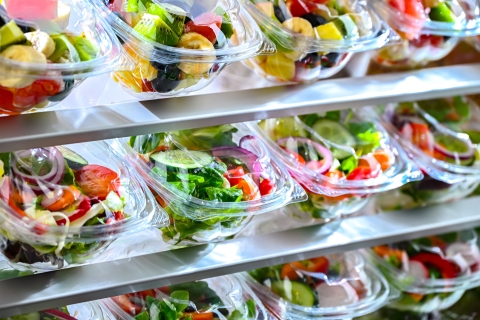
recycle serviceverpakkingen

Fost Plus as a driver of change

Fost Plus is supporting its members in the transition to sustainable materials management. It is clear that the impact will be different for each sector, as will the solutions. Some products can be sold or shipped without packaging, for others the challenge lies in setting up logistical return systems, and in yet other cases the main focus is on recycled content.

Together with our members, we explore different paths and try to offer solutions. By sharing best practices and successful projects, we aim to inspire companies and encourage cross-pollination between different sectors.

Do you want to explore options for the reduction and reuse of your packaging, but are you not yet sure where to start? Are you looking for the right partners? Are you working on a prevention or reuse project but have you got stuck somewhere? Or do you just want to share a successful experience? We’d love to hear about it! Use our contact form to get in touch.

Maybe you also want to read this?

Top Brands
Reuse

Reusable packaging in the catering sector – is now the time to get started?

21/01/2025

MatchMaker
Reuse

MatchMaker: ‘dating tool’ for partners in reuse and prevention

10/02/2025

reuse shelf
Reuse

Bulk and reuse increasing in stores, but Belgian consumers are still hesitant

28/11/2025

Top Brands
Sorting out of home

Sorting in the food service industry: Top Brands leads by example

21/05/2024