
The e-commerce sector in Belgium is growing. At the same time, it is under pressure to reduce packaging waste. The Packaging & Packaging Waste Regulation (PPWR) states that the amount of packaging waste per capita must be reduced by 5% by 2030. For smart companies, this presents numerous opportunities to innovate. Large players are demonstrating that eliminating shipping packaging and minimising packaging deliver immediate benefits in terms of costs and customer satisfaction. New models such as return on the go and return from home are pointing the way to circular e-commerce.

On this page, you will discover the main impact of PPWR for key economic actors and producers in the e-commerce sector, as well as the most important trends and innovations.

webshop

PPWR for the e-commerce sector

Timeline PPWR

This list is not exhaustive: it contains the most important points from the PPWR that are relevant to e-commerce companies and specifically to e-commerce packaging. More information can be found on our PPWR page.

Please note: The European Commission is still working on an official FAQ and additional delegated and implementing acts, which may contain further clarification or changes. These documents have not yet been published. Keep an eye on official EU sources and national guidelines for the latest information. Fost Plus is not liable for any inaccuracies or omissions in this list, or for the consequences of actions taken on the basis of it. We recommend that you first seek legal advice.

For producers* 

a. Prepare for registration in each EU country where you supply products (2027): once the national PPWR register opens in each Member State (18 months after the February 2026 implementing act), your company must be registered in every country where you place packaging on the market. This also applies to shipping packaging.

b. Prepare your data and keep it up to date in accordance with Annex IX (reporting from 1 June after the first full year): record the quantity and type of material, the type of packaging (primary/secondary/transport packaging) and reusable packaging systems (if applicable) for each order. This information must be submitted annually.


For marketplaces:

a. Introduce a seller compliance check in 2025-2026: Check that all sellers (and non-EU sellers in particular) are EPR-registered in the country of delivery. If not, you are automatically considered a producer under the PPWR, with all the associated obligations. 
See details in PPWR Art. 44.
 

For non-EU producers selling online to EU customers:

a.  A non-EU producer selling within the EU via distance selling is subject to the same obligations under the PPWR as any producer (see responsibilities of producer above), including compliance with Articles 5-12, drawing up and maintaining the EU declaration of conformity and technical documentation (Article 15) and registering and reporting for EPR in each Member State where packaging is made available (Article 44 and Annex IX). The PPWR allows these obligations to be fulfilled by an authorised representative by a written mandate, without any transfer of legal responsibility, which remains with the manufacturer (Article 17, paragraphs 1-3, PPWR).

*Producer: makes packaging available for the first time in a Member State (e.g. Belgium) and may be the manufacturer, importer or distributor (authorised representative for EPR if the producer is not established in the Member State.

a. The PPWR requires companies to reduce their packaging to the bare essentials by 1 January 2030: as little material as possible without compromising safety, hygiene or convenience for consumers.

b. By 2027, harmonised European standards will be developed that clarify when packaging is no heavier or larger than necessary, and how to prove this as a company.

See details in PPWR Art. 10.

The PPWR states the following (Art. 24(3)):

a. The empty space is the difference between the total volume of the transport package and the volume of the products in their sales packaging.

b. Filling materials (paper, airbags, bubble wrap, foam) are considered empty space.

c. The European Commission will establish a mandatory calculation method by 12 February 2028 (Art. 24(2)).

d. An exception is provided for sales packaging that is also used as e-commerce packaging and reusable packaging within a reuse system.

More details in our blog post. See details in PPWR Art. 24.

This applies to the packaging types listed in Article 29(1): pallets, folding crates, boxes, trays, plastic crates, IBCs, pails, drums and canisters. What is more, this packaging must be fully reusable from 2030 in internal logistics within Belgium or between linked companies in EU Member States. Article 29(4)(d) explicitly excludes cardboard boxes.

See details in PPWR Art. 29 – more details here

This means it must meet the design-for-recycling criteria set out in the delegated acts (Article 29(2)(a)). Packaging must achieve recyclability class A, B or C from 2030, and class A or B from 2038. The European Commission will establish detailed design-for-recycling criteria by 1 January 2028. Article 29 (11) contains a list of exemptions from the recyclability requirement.
Read our blog post or see all the details in PPWR Art. 6.

R-strategies in e-commerce

Below, we share our insights on possible strategies and offer inspiration for experimentation and innovation by companies.

Preventie

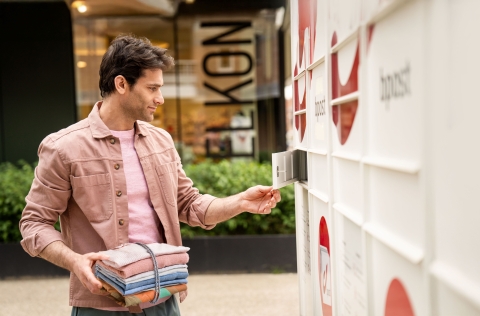
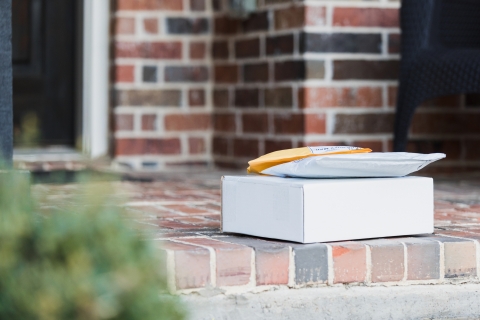
A growing number of e-commerce companies already ship products directly in their original packaging box: this is also known as the no pack strategy. Customers are usually given the option to indicate their preference on the website. Eliminating packaging also offers direct benefits for e-commerce companies.
locker

Packaging lines are being optimised all the time based on the product to be transported. Innovations are constantly being developed to ensure that the packaging material used is minimal and as light as possible.
verpakkingseliminatie
Hergebruik

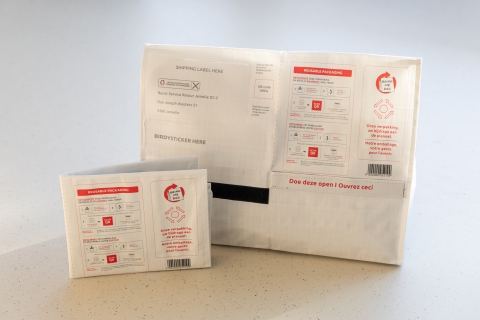
E-commerce companies can offer consumers the possibility of receiving goods in reusable packaging, which they can return to designated collection points – often in exchange for a small reward. Producers can then clean and reuse this packaging for future shipments. Numerous new innovations and pilot projects are currently being developed and tested in the sector.
hergebruik e-commerce

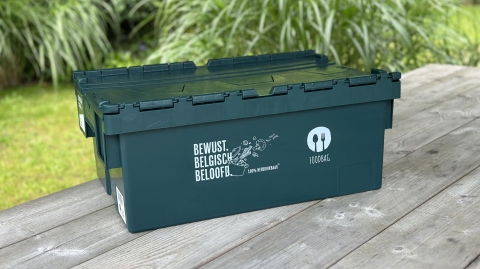
Consumers can receive meals or groceries that they have ordered online in a reusable box or bag. They can then return the reusable packaging when they receive their next delivery, usually in combination with a reward or deposit to encourage returns.
Return from home
Ecodesign

The recyclability of e-commerce packaging can be improved by avoiding the use of materials that cannot (or cannot easily) be separated by the consumer. For example, a paper envelope with plastic bubble wrap is replaced by a paper envelope with paper filling. Also, avoid using plastic packaging with carbon black pigments on the outside: prefer other colours. These are two simple examples, but recyclability is a complex matter. Feel free to contact us when you are designing or redesigning your packaging to be sure that your new packaging really is recyclable.

enveloppe

Fost Plus as a driver of change

Fost Plus is supporting its members in the transition to sustainable materials management. It is clear that the impact will be different for each sector, as will the solutions. Some products can be sold or shipped without packaging, for others the challenge lies in setting up logistical return systems, and in yet other cases the main focus is on recycled content.

Together with our members, we explore different paths and try to offer solutions. By sharing best practices and successful projects, we aim to inspire companies and encourage cross-pollination between different sectors.

Do you want to explore options for the reduction and reuse of your packaging, but are you not yet sure where to start? Are you looking for the right partners? Are you working on a prevention or reuse project but have you got stuck somewhere? Or do you just want to share a successful experience? We’d love to hear about it! Use our contact form to get in touch.

Maybe you also want to read this?

BringMeBag
Reuse

Reusable Bag: Towards Reusable Packaging for Parcel Delivery

10/02/2026

Herbruikbare box Foodbag
Reuse

Belgian and Sustainable – Foodbag’s Reusable Boxes

03/12/2025

webshop
Prevention

Sustainable shipping in e-commerce: five sources of inspiration

12/11/2025